
In the world of digital marketing, nothing is more critical than understanding your audience — and it all starts with keyword research for SEO. Whether you’re writing blogs, launching ads, or optimizing product pages, the right SEO keywords can make or break your online success.
If you’ve been struggling to find the right words to rank higher, attract traffic, and convert clicks into customers, then this guide is your go-to resource.
What is keyword research for SEO?
Keyword research means finding out the words and phrases your target audience types into search engines when looking for information, products, or services. These SEO keywords help you understand what your target audience wants, how they search, and how to match your content to their intent.
Proper keyword analysis doesn’t just help with rankings — it helps you build content that solves real problems, answers questions, and drives conversions. The process involves using keyword tools to uncover data such as search volume, competition, trends, and cost-per-click (CPC) if you’re also running paid campaigns.
Why Keyword Research is the Backbone of SEO?
Think of your website as a building. First, consider your content as the framework; next, your design adds the visual appeal. Most importantly, your SEO keywords serve as the true backbone — the foundation that supports and strengthens your entire SEO strategy.
When you choose the right SEO keywords, you’re not just guessing what people might search for. You’re strategically inserting proven, data-backed terms that lead users straight to your content.
https://digitalsmriti.in/
For this reason, businesses across the globe treat keyword research for SEO as the first and most important step in any SEO strategy.
Types of Keywords in Keyword Research for SEO:
To get the most out of your keyword research for SEO, it’s essential to first understand the different types of keywords and how they work:
1. Short-Tail Keywords
Short-tail keywords consist of one or two words and attract a high volume of searches Examples include “mobile” or “SEO.” While these can attract a lot of traffic.
Use them carefully, typically as part of a broader strategy to maximize their effectiveness.
2. Long-Tail Keywords
Long-tail keywords are more specific and usually three or more words long, like “best running shoes for flat feet.” These keywords have lower competition and higher conversion rates.
In fact, for businesses , targeting long-tail keywords is often the quickest way to gain visibility.
3. Local Keywords
If you’re a business serving a specific area, then local keywords are a must. These include phrases like “best coffee shop near me,” which help you target customers in your region.
Moreover, local keywords helps businesses rank higher in local search results and connect with nearby customers.
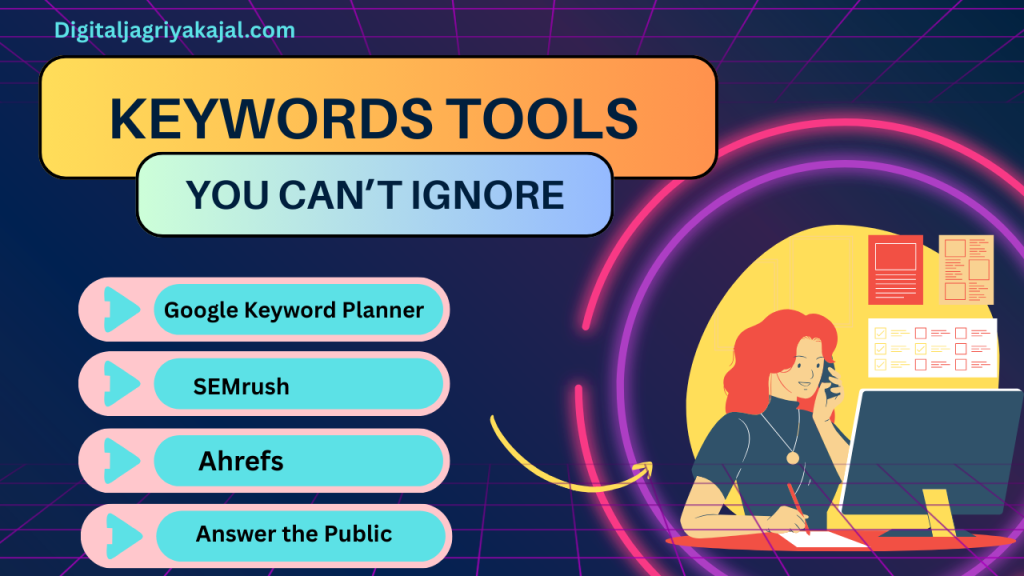
Keyword Tools You Can’t Ignore for Keyword Research for SEO.
Fortunately, thanks to modern technology, you don’t have to guess which keywords are working—you can rely on a variety of keyword tools for keyword research for SEO to gain accurate insights.
https://digitaljagriyakajal.com/
Some of the best tools for keyword research for SEO include:
- Google Keyword Planner is a tool where keyword can be searched and effective PPC campaigns can be created.
- SEMrush – Great for competitor research and in-depth keyword analysis.
- Ahrefs – Ideal for finding backlink opportunities and high-traffic long-tail keywords.
- Answer the Public – Useful for finding questions people ask around a topic.
How to Perform Effective Keyword Analysis for Keyword Research for SEO?
Once you’ve gathered a list of keywords, the next step is conducting keyword analysis. This means evaluating keyword Research for SEO based on:
- Search volume is how many times a keyword is searched each month.
- User Intent: What the audience actually wants
- Relevance: Does this keyword match your business goals or niche?
The goal of keyword analysis is to find the sweet spot — keywords that are relevant, high in volume, but low in competition. This is where you’ll find your Keyword Research for SEO gold.
Strategically Using Keywords in Your Content
After selecting your keyword research for SEO and analysis, the next step is to apply your findings effectively. But keyword placement isn’t about stuffing words everywhere — it’s about natural flow and relevance.
Here’s where to place your SEO keywords for best results:
- Page titles and meta descriptions
- Headings (H1, H2, H3)
- First 100 words of your content
- URL slugs
- Image alt tags
- Anchor text in internal and external links
Additionally, don’t forget to include long-tail keywords and local keywords naturally within your content. These not only help you rank for voice search but also target highly specific user queries.
Common Mistakes to Avoid in Keyword Research for SEO
While tools and strategies are useful, there are a few pitfalls to watch out for:
- Ignore user intention: If a keyword has high volume, it doesn’t mean it’s right for your audience.
- Focusing only on volume: A keyword’s real value also lies in how well it converts.
- Not updating your research: Since trends change constantly, it’s important to regularly revisit and update your keyword research for SEO strategy.
Final Thoughts: Art of Keyword Research for SEO
Whether you’re a small business owner, a content marketer, or a large enterprise, understanding how to use keyword Research for SEO, select the right keyword tools, and perform meaningful keyword analysis helps you to get to know your audience’s intent and the advantage you have to stand out.
To begin with, start simple. Focus on long-tail keywords and local keywords that align with your audience’s interests. Then, use reliable keyword tools to gain valuable insights. Let data guide your content decisions at every stage. Above all, remember that effective keyword research for SEO is the true backbone of your strategy—get it right, and everything else will naturally fall into place.
Very good partnership https://shorturl.fm/68Y8V
Thanks
https://shorturl.fm/oYjg5
Thanks
https://shorturl.fm/9fnIC
Thanks
https://shorturl.fm/A5ni8
https://shorturl.fm/N6nl1
https://shorturl.fm/m8ueY
https://shorturl.fm/j3kEj
https://shorturl.fm/5JO3e
https://shorturl.fm/YvSxU
https://shorturl.fm/5JO3e
https://shorturl.fm/xlGWd
https://shorturl.fm/xlGWd
https://shorturl.fm/Kp34g
Monetize your influence—become an affiliate today! https://shorturl.fm/mRoFQ
Unlock exclusive rewards with every referral—apply to our affiliate program now! https://shorturl.fm/YWx7v
Get paid for every referral—enroll in our affiliate program! https://shorturl.fm/zwySS
ok Thanks
Drive sales and watch your affiliate earnings soar! https://shorturl.fm/ltDlC
ok Thanks
Share your unique link and earn up to 40% commission! https://shorturl.fm/5KwNJ
Sign up for our affiliate program and watch your earnings grow! https://shorturl.fm/pa77L
Sign up and turn your connections into cash—join our affiliate program! https://shorturl.fm/wqgnI
Apply now and receive dedicated support for affiliates! https://shorturl.fm/H0bW1
Earn up to 40% commission per sale—join our affiliate program now! https://shorturl.fm/kNUOu
Partner with us and enjoy recurring commission payouts! https://shorturl.fm/0jYYU
Drive sales, collect commissions—join our affiliate team! https://shorturl.fm/2zmc5
Earn passive income this month—become an affiliate partner and get paid! https://shorturl.fm/f7ZbG
Invite your network, boost your income—sign up for our affiliate program now! https://shorturl.fm/m8oP4
Promote our brand, reap the rewards—apply to our affiliate program today! https://shorturl.fm/uhmbw
Sign up now and access top-converting affiliate offers! https://shorturl.fm/9F6nX
Drive sales, earn big—enroll in our affiliate program! https://shorturl.fm/2fN0U
Join our affiliate community and start earning instantly! https://shorturl.fm/mdgUe
Join our affiliate community and maximize your profits—sign up now! https://shorturl.fm/IHgN6
Your influence, your income—join our affiliate network today! https://shorturl.fm/d2t4x
Start earning on every sale—become our affiliate partner today! https://shorturl.fm/SXgm8
Drive sales, earn big—enroll in our affiliate program! https://shorturl.fm/4xiQO
Maximize your earnings with top-tier offers—apply now! https://shorturl.fm/ORd42
Refer friends and colleagues—get paid for every signup! https://shorturl.fm/c6Prg
Be rewarded for every click—join our affiliate program today! https://shorturl.fm/GqFlH
Join our affiliate community and earn more—register now! https://shorturl.fm/lmHss
Start earning on every sale—become our affiliate partner today! https://shorturl.fm/BRyh2
Join our affiliate community and earn more—register now! https://shorturl.fm/lmHss
Start earning instantly—become our affiliate and earn on every sale! https://shorturl.fm/uqvlm
Be rewarded for every click—join our affiliate program today! https://shorturl.fm/JwSPF
Sign up now and access top-converting affiliate offers! https://shorturl.fm/10QRT
Share our offers and watch your wallet grow—become an affiliate! https://shorturl.fm/4FRtq
Monetize your audience—become an affiliate partner now! https://shorturl.fm/CVYqZ
Your audience, your profits—become an affiliate today! https://shorturl.fm/N6GMX
Promote our brand, reap the rewards—apply to our affiliate program today! https://shorturl.fm/wlZSn
Start sharing, start earning—become our affiliate today! https://shorturl.fm/eYZqj
https://shorturl.fm/AUnGj
https://shorturl.fm/aFTV0
https://shorturl.fm/AQJ6q
https://shorturl.fm/YKKXD
https://shorturl.fm/XOXFL
https://shorturl.fm/d3kjm
https://shorturl.fm/xSeM2
https://shorturl.fm/M3M6C
https://shorturl.fm/yEGco
https://shorturl.fm/xJbtY
https://shorturl.fm/V8nHL
https://shorturl.fm/6uYu3
https://shorturl.fm/31FvM
https://shorturl.fm/1fhTp
https://shorturl.fm/o1sWq
https://shorturl.fm/WV4ud
https://shorturl.fm/jV0Ai
https://shorturl.fm/IJqD1
https://shorturl.fm/MpeH4
https://shorturl.fm/ApHI2
https://shorturl.fm/kpaLA
https://shorturl.fm/qDyOE
https://shorturl.fm/rCitB
https://shorturl.fm/AreW6
https://shorturl.fm/8dAsT
https://shorturl.fm/UJCmj
https://shorturl.fm/nWHCx
https://shorturl.fm/XHmeO
https://shorturl.fm/TBImU
https://shorturl.fm/a79sN